I’m going to dive into a specific case of a “beta reader” here, but the principles are the same for just about anything related to the process of getting a book published.
First, a reminder of the general rule: If an organization is pretending to be a legitimate traditional publisher and they ask you for money, then they’re not. They’re one of a vanity publisher, a hybrid publisher, or a scam. Of those three, the only time you’re likely to see value for your money is if they’re hybrid, and even then check references, then see if you can check authors who have used them but aren’t on the reference list.
This morning, someone posted this on a writer’s group:
My name is Karen [redacted] I’m a Beta Reader who helps authors improve their work with clear, thoughtful feedback. If you’re preparing to publish, I’d love to support you—with both feedback and professional formatting to get your book ready for readers.
I was going to post the rest of the pitch, but the post was been removed, either by the group admin (or by the poster after my response to asking for references). “Karen” offered to be a beta reader, to provide feedback, and to help with book formatting because “she” just loves to help authors.
UPDATE: Now “she” is commenting on posts, so I got the full text again, now above.
The first two flags are right there in the pitch. There’s no mention of genre. It’s not often that someone is an avid reader of any genre, and even if they are, how much genre-specific feedback could they offer? Suspicious. Second is the mention of “book formatting”. That sounds like something one might be charging money for. My first thought is that this is a lead in to an outright scam, where “Karen” loves your book so much that “she” wants to hook you up with a friend in the [scam] publishing business. For only US$1,500 you can be $5,000 poorer! (Seriously, that’s how it works, once you send money, they know they have a mark and they keep asking for more money for printing, marketing, etc. etc. until you either clue in or run out of money).
There’s another possible risk here, and it’s huge: you send your nearly-finished manuscript to someone you don’t know, next thing you know, your book is up on Amazon under another name, and since they “published” first, getting it taken down is borderline impossible. I can’t think of a worse scenario.
Here’s a general process to go through when checking anything like this out: go to the user’s profile and take a look at their personal posts, where they claim to be from, and their friends list. Reverse image search their profile picture with TinEye.
This is what I got for “Karen”:
“Karen’s” surname is a common given name, not a surname. Okay, maybe they’re using two given names for privacy reasons but… suspect nonetheless.
The profile image was just some stock shot of a pen on paper. That’s not even worth searching. But if they have a head shot, then TinEye is great. These days there’s fewer hits because the scammers are using AI to create new people each time, but if they’re lazy it’s not uncommon to find the image listed on scam tracking sites. Still, a pen and paper is pretty weird for a personal page. Flag number three.
There were no posts to this account before December 4, 2024, roughly five months ago. That’s suspect. Flag number four.
“Karen” claimed to be born and raised in New York City. Let’s take a look at the 400+ friends associated with the account. Almost all of them are based in India, and nearby Asian countries. In the first 200 or so, not one in New York, and only two in the US[LN]A. Flag number five.
The post feed is all news-y, current posts feature the current president doing various things, then back in December they’re Biden doing various things. Not a single personal or reading-related post. Flags six and seven.
Now we do a web search, there’s no indication of this person on any of the reading-related sites (Goodreads, The Story Graph, etc.) Flag eight.
Head over to Linkedin (if you can stomach it), search the name there. Not a single profile with that name. Flag nine.
There’s no blog/website/presence at all under that name, save for this Facebook profile. Flag ten.
Ding! Ding! We have a loser!
Five flags is more than enough to call this a scam, but I thought I’d go through the whole process to illustrate what the first steps should be to avoid getting ripped off. Even when someone passes these checks, you’re back to the general rule above: obtain and check references. The number of people out there looking to take advantage of authors who are desperate to get their work out there is off the charts.
I just read an essay, Why I Cannot be Technical, by Dr. Cat Hicks. It’s a long read and it offers a personal view into her thinking, her work, and what it is to be Technical (and although she doesn’t use the phrase, I read one part of what she’s calling Technical as what I’d call “Bro Culture in Tech”, more specifically in software development).
There’s a lot packed into that essay and for anyone working in software, or working for a company that is focused around software, I’d recommend first a careful read with a view to deconstructing many of the overlapping topics there, then following those to her work on software developers and technical teams.
I’m not really sure how this post is going to go, but I expect it to have a similar number of overlapping topics. My apologies in advance if this also requires some diligent reconstruction.
I’m an outlier. I think a lot of people in software development have characteristics that a diagnostician would associate with autism, and I’m certainly one of those people. This has been the basis of much of my success. In particular, it’s allowed me to seek and thrive on the most inhuman of projects, the high-pressure tight-deadline, hero-or-zero projects that I’ve always enjoyed and delivered on. It’s also been the basis of my under-performance, my inability to integrate into a team well, my proclivity to speak the truth, to say “hey what about that elephant?” in meetings, the times when I state something I think should be self-evident, only to be met with a few seconds of silence and then “well Alan, why don’t you tell us what you really think?”, and my below-par performance when the building is not actually on fire.
For this reason, aside from a few brief periods where I was an actual employee, and until I got utterly derailed in my mid 40’s (more on that later), I’ve been a contract developer, or in modern parlance, “gig worker” for most of my career. I set up my first home office in 1981, when it was such a radical idea that many people couldn’t get past the cognitive disconnect the phrase inspired. Many of my peers (or more specifically my male peers) wound up moving to the US, to Silicon Valley, Redmond, or the Tech Triangle in NC. They set down roots, earned salaries that I couldn’t dream of, put their names on patents, and rose through the ranks. Mainly retired now, they travel the world, visit grandchildren, and so on while I still work to give my life any meaning that endures beyond the people who will remember me when I’m gone.
Even when I found long term contracts where I could be successful, my tenure was limited. I will digress into an example where shortly before I arrived a woman was parachuted in as Director of IT and proceeded to engineer the bro middle managers out. This company had a department of maybe 15 staff, and three, count ’em three middle managers. For context, we’re talking the mid-90’s here, well after most companies had thinned their middle management ranks to the bone, so this was borderline archaic. The manager I reported to had this incredibly complex system of spreadsheets that he used to explain why a ten minute change to a system would take three months to deliver. He was the first to go. Terminated shortly after the new director correctly determined that 85 days of that three months would be consumed by staff filling in forms and his tweaking those dreaded spreadsheets. He did not go softly, at the party thrown for his departure at a local strip club, a long-standing departmental tradition, he ranted about how incompetent she was, how the entire department was going to hell. Many male staffers in attendance agreed vigorously, causing the exposed breasts of the women sitting on their laps to jiggle. I may be a heterosexual male who is also fond of boobs, but I still can’t find words to capture my revulsion, my disgust at this display. The other managers and a bro staffer all took this to heart, found other jobs and resigned in short order. It was only after the third departure that one of the women in our department (our female ranks had doubled to two, thanks to new hires) suggested that maybe, just maybe we could have have her manager’s departure party at a place where she too could feel comfortable. What a radical idea!
I spent the better part of two years at that job, and wrapped up a major project. In the absence of middle managers, I reported to the director, like everyone else. When offered a contract extension, there wasn’t a critical project coming up, and I sensed I would get bored, under-perform, and eventually not be offered another extension. Cycling back to what Dr. Hicks references in her post, she built a much more human IT department during her tenure. The mood and morale of that group was far higher when I left than when I arrived. I laughed a bit after writing that, because in part that humanity also made it a place where I was less likely to excel.
A few years earlier I got called in to save a project that was unsalvagable. I can work the occasional miracle, but not after the customer has sent a letter that amounts to “stop all work and get your stuff out or it’s going into a dumpster, any responses should go to our lawyer”. But that particular disaster was a symptom of some much deeper issues, and in short order I found myself responsible for all of engineering, in charge of a department of some 15 software developers and engineers. Just one of those was female and on the customer engineering side of the shop. During my introductory meetings with my new team, she’d identified a stability issue in our product but said nobody would listen to her (anyone surprised?) I took the issue up with our lead developer who dismissively asserted that the product was perfect, and that it was an application issue. So I bought a diagnostic tool that simplified the identification of software flaws, gave it to her, and let her run with it. A day later, she’d identified the null pointer dereference that was crashing the system (and a handful of other customer installations). We presented this hard evidence to the lead developer (together, because I expected if she gave it to him alone, it would be dismissed yet again), got the problem fixed and in the process finally got a system in production sufficiently stable that the customer released a rather substantial final payment. I also put a lot of effort into a “check your ego at the door” culture. We had some very talented developers and we had some average developers, but my experience is that everyone has strengths and most of the time you can find a place to let them thrive. One wasn’t the best at writing new code, but was an absolutely meticulous tester. Another was extraordinary when communicating with customers. I tried to fit them into places where they could use their strengths. One day just before a long weekend, I had a screaming match with our CEO, who attempted to manufacture a crisis that would have kept our team working through the weekend. Personally, I’ve never been much into this work-life balance thing, but the people who reported to me were largely neuro-typical, and I felt I had a responsibility to give them what balance I could. False crisis averted, they got a much deserved weekend and the knowledge that I’d risk everything to defend them. After a year, the problems I could fix had been fixed and I moved on. I hope that I left a more human friendly place in my wake.
All that is a prefix to the career path of the woman in this story. Some time after I left, she moved to another company to run a team of her own. This felt like an achievement. Someone I’d mentored went on to a leadership role in tech! But then not too long after that she switched to a sales role. My guess is sales offered more money, more humanity, less sexism, and more people who would actually listen to her. A few years later I worked with a founder of the company she went to on another project and if anything this reinforced my guess.
In my experience, software development is a career that does an excellent job of chewing people up and spitting them out. Most of the men I know in my cohort got out of coding early by their 30’s, the women years earlier than that. Some moved to management, some to things like technical sales support, but the vast majority into something distant from writing code (for example, farming). I can think of just one woman who stuck with it through to retirement. I think the industry favours young developers straight out of school not only because they are quick to learn and become productive, but also because they’re easier to exploit. It’s harder to put in twelve hour days when you have to go pick your kid up from daycare because your wife left you for working twelve hour days all the time.
I spent much of my career working for small businesses and startups, many of which were working on ideas that could have become billion-dollar businesses, putting in the stupid hours, all in hopes of one day coming out with a massive payout that I could subsequently use to build rocket to Mars and the like (yep, I thought much like “that guy” as much as it pains me to say that now). I think this is still the underlying driver that lets the software industry abuse its practitioners: the “hey if this works, the options will pay out in the millions and it will all be worth it” myth. Legends of early Microsoft employees cashing out in the millions looms large in tech culture to this day. All this despite the fact that large investors have come up with elaborate ways to screw employees out of any real wealth, with pre-IPO dilutions, layoffs just before options trigger and other manoeuvres from the Capitalist Asshole Playbook.
During the dot com boom, two friends of mine got involved in a startup that scored, big. They both came out wealthy enough to never need to work again, but not wealthy enough to throw them into the ranks of the uber-rich. One of them was more than a friend. We were close enough to be brothers. Instead of all that money becoming a platform to do more, to do better, it triggered a series of events that caused him to lose his way and within a few years he was gone. Gone in his early 40’s, with so much more left to do.
It took some time for this loss to take it’s full toll on me. Subconsciously, the entire point of becoming rich enough to do “great things” was eradicated, replaced with become rich and spend the rest of your life shepherding your assets as investments or do something dumb that ends your life. A main pillar of how I framed my existence had been destroyed. After he died, I did a couple more “impossibility remediation” projects and then slipped into a fifteen year-long set of cycles through mild to moderate depression alternating with thinking I’d pulled out of it. The years that should have been my most productive were so attenuated that they were essentially lost. I kept coding though, offering up some products that were minimally successful in their niche markets (successful in that they at least paid back more in revenue than the hours I put into them). I wrote some reasonably cool open source stuff and made several attempts at bringing new ideas to a minimal viable product stage, without success. Even in less severe cases like mine, depression is a bitch. There’s no real way to communicate that unless you’ve been there, but what I can say is that I remain exuberant at having gotten past it, am as confident as possible that it’s not coming back, yet vigilant for some other thing that could trigger a brand new wave.
As I write this, I wonder (as you probably do, having gotten this far) what my point is, and how it relates to Dr. Hicks’ essay.
In part I think I’m trying to illustrate by example a point that Hicks makes.That even when one is Technical (in the specific way that she uses the term), it is not possible to be Technical. Technical is a construct we willingly create for ourselves and subscribe to provide meaning to our work, our lives. It isn’t real, and like any construct it makes those who believe it subject to manipulation by others. Capitalism is more than happy to perform that manipulation to it’s advantage and to the detriment of people, of humanity.
My other point is that Technical, as currently practised, is intrinsically elitist, sexist, ableist (possibly unless you’re a functional autistic), and a whole mess of other negative -ists. I think anyone in the field, even the boy genius super-programmers, will benefit greatly by developing an understanding of Hicks’ work. I mean, even if your own personal development powers are god-like, understanding what she’s learned will benefit the semi-useless plebes on your team and help them get out of the way, so it’s like totally worth it. Yes, you may read that last sentence fragment in Valspeak.
A few weeks back, we got hit with a heavy ice storm, and the damage to our grounds was pretty extensive. Our house, garage, gardens, and fences were spared, although there were a few close calls. We’re waiting for our “tree guys”, Saunders Tree Service, to take care of customers with more urgent damage before they come in and clean up “the big stuff”. Meanwhile I’m waiting on an electric chainsaw from Ego to arrive. I’ve got all the safety gear, I just need something a little more capable than the bow saw I usually use for branches and small trees. Sawing is a great workout, but if I were to stick with a manual approach I’d be at it until the fall, at least.
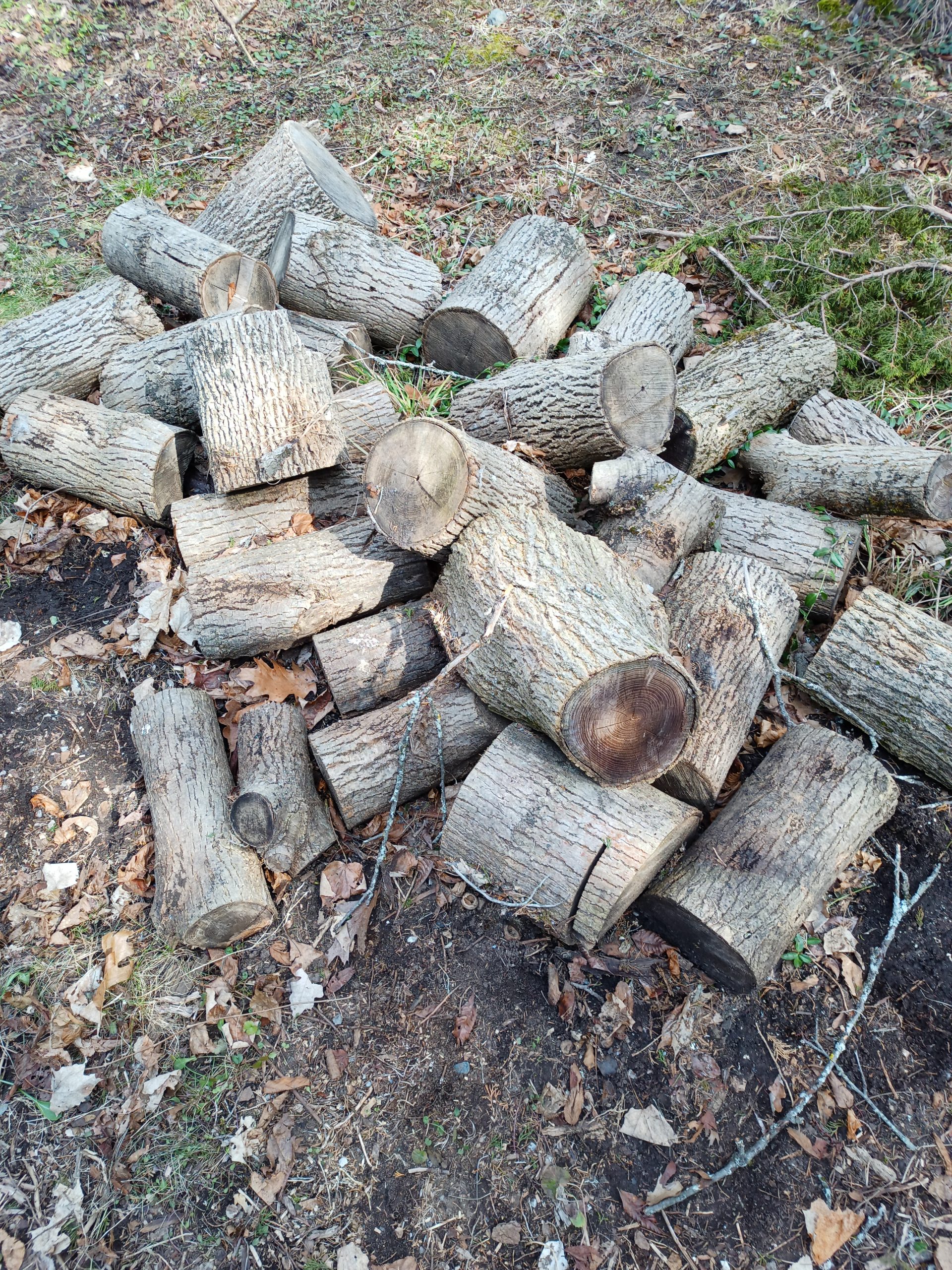
Meanwhile, we’ve got firewood-length logs hanging about, the result of taking out some dead Ash trees and so-called Manitoba Maples in previous years.
About 1/4 of the logs left to split
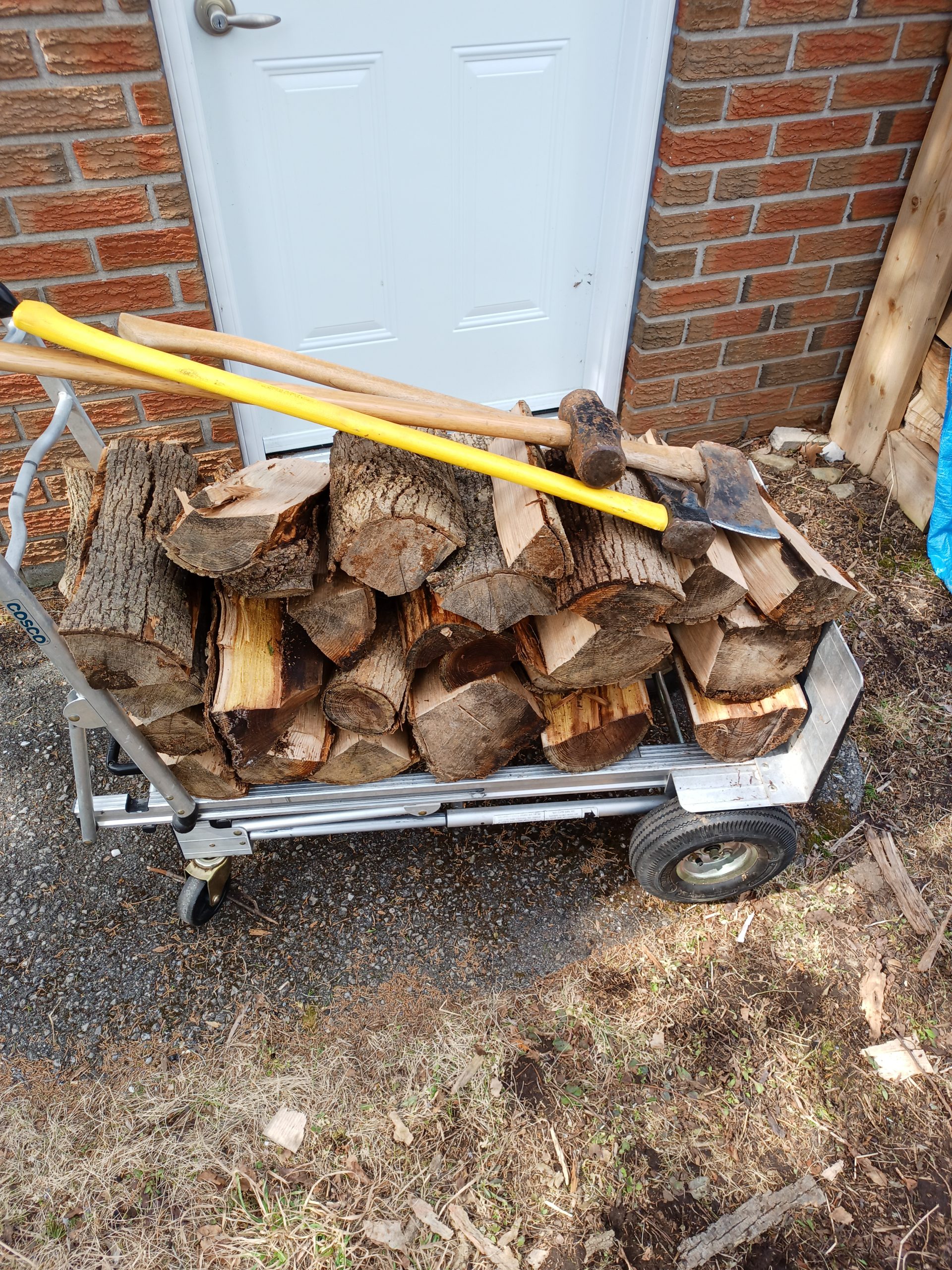
We’ve got an electric “5 ton” log splitter, but it’s just not up to this job. It’s time to dust off the traditional tools, namely a splitting axe and a sledgehammer. Splitting wood makes sawing branches seem like a jog in the park. It’s tough work. Bashing away at these logs brought back memories of being a child, going to Christmas dinner at my step-grandfather’s place. In hindsight, I realize that “Old Man Wood” as he was known (then in his 90’s so the moniker was well-earned) ran an estate that was the closest thing to a Lord’s manor that we’ve ever seen in Canada. The main house had something like 17 bedrooms in a wing that was never used and not in the best repair. A dance hall with four organs, one in each corner (also not in great repair, only two still worked), two greenhouses, two dining rooms, with a partition between them that would get opened for big holiday dinners, and two parlours, one with a grand piano. The kitchen featured an ancient wood stove, possibly two. The estate had three houses for “the families”, which I just now realized were probably much like the farmers in Downton Abbey, despite this being the 1960’s! Last time I dropped in, curious to see how it had fared, his descendants had fixed the place up and were running it as a B&B.
What reminded me of dinners there was the memory of the young farm hands in a woodshed attached to the kitchen, splitting logs to feed the stove that would in turn cook a feast for about 30 people. My recent efforts at splitting logs made it clear why it was a job given to those with younger, stronger bodies. My current capacity for a session of log splitting is merely one dolly load.
Just a little less wood than I can manage to split in one session.
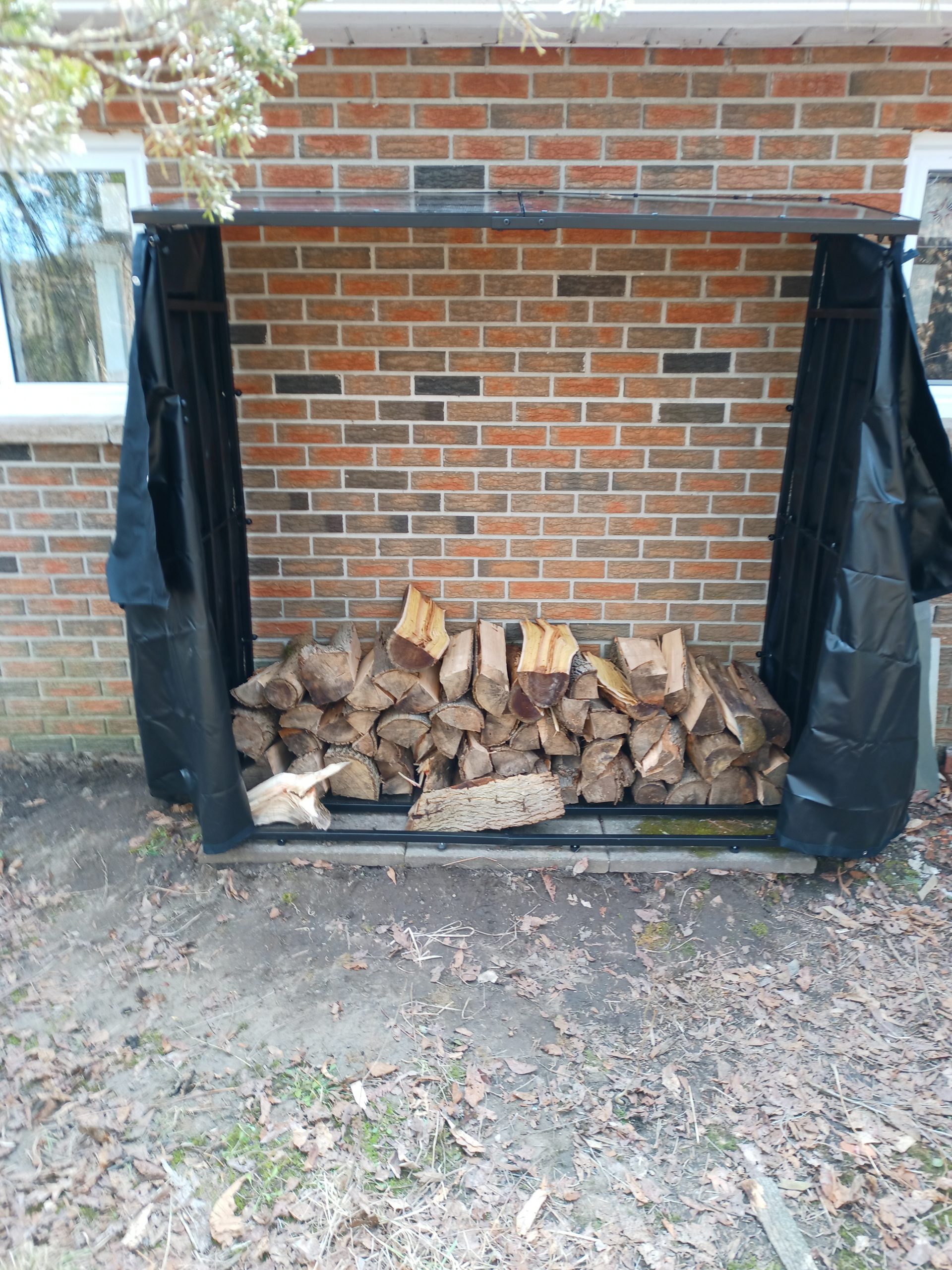
This particular load is a little less than I could manage on a day dedicated to splitting. It’s a little less because we also need a place to store the wood. Thus the first part of the day was turning a box full of parts into this storage rack:
A newly assembled firewood storage rack.
The assembly instructions for this thing score about 3.5 on the accuracy and readability scale (for a reference IKEA instructions tend to score an 8). Notably, the absence of some detail for parts orientation led to a little disassembly and reassembly. In one case the wrong bolt was specified, but thankfully the kit supplied the correct amount. They could have also changed the order of assembly and both avoided the ambiguity that led to work done twice, as well as eased assembly (I often use my height and very long arms to successfully ignore “needs two people to assemble” instructions, a slight change in order would have made the process even easier).
The image above shows the results of two days splitting wood, although the first day also involved excavating the space for the rack and dropping in some old and very heavy patio tiles, and the second assembling the rack. I may be ambitious here, but I’ll be aiming for two dolly loads per day. If I can manage that, this rack should be nearly full in about four or five days.
The latest update on the chainsaw is either Thursday this week or the week after, and we have another smaller rack on the way that will be dedicated to kindling-sized wood. That’s step two, and I expect we’ll have enough kindling to last more than a year, maybe two if we ration it.
At some point, cleanup steps will become sufficiently mixed with ongoing maintenance and peripheral storm-related damage that the distinction will be lost, but that seems a long way off at the moment.
It is a “how the hell is it Friday already?” kind of week. It’s been a combination of ongoing clean-up from the ice storm, restocking, general maintenance, and a dollop of guilt. Hopefully the guilt will help me keep this short.
Over the years, like everyone else in the area, we’ve lost all but our youngest Ash trees to the Emerald Ash Borer Beetle. This has left us with a good number of logs lying about, cut to firewood lengths by the crew we hire to take them down. Cleanup from the storm is going to increase that substantially, as well as provide a big supply of smaller branches that will make good kindling. Last week we cleared some new space for a new wood storage rack, and I spent Monday afternoon splitting logs. We’ve got a little “5 Ton” electric splitter that does a great job on smaller logs but chokes on these. So I got the wedge axe and the sledgehammer out and took to splitting them old school. Man, that’s tough work, but I made a significant dent in the pile before running out of steam.
I had planned to pick The task up on Tuesday, despite some complaining muscles, but winter is still hanging on and had other ideas:
A week into April and winter is still hanging on.
There are still many other small jobs to take care of, so the rest of the day was spent getting something done, warming up, getting another thing done, warming up, and so on. Biggest achievement: getting the cable back on our laundry line, after I managed to knock it off while trying to clear it from ice. It took me a while to remember that the way to get this done is not to set a ladder in a precarious position on the tree the far end is attached to, fearing that one slip will send me crashing onto the large rocks below, but to disconnect it at the house side, stretch up (I can just barely reach it), pull the wheel assembly off, re-thread the line, hook it back up and then do the tough part, which is re-tensioning it, back at the house where it can be dropped to chest level. I’m hoping that when this inevitably happens again, I remember this instead of spending 30 minutes re-discovering a non-life-threatening solution all over again.
I also managed to release NovelWriterExtract, a tool that will be of use for a specific kind of writer who is highly analytical when it comes to reviewing their work, and who is using novelWriter as their writing tool. So, like maybe five people. But hey, I’m one of those five and I’m happy about it!
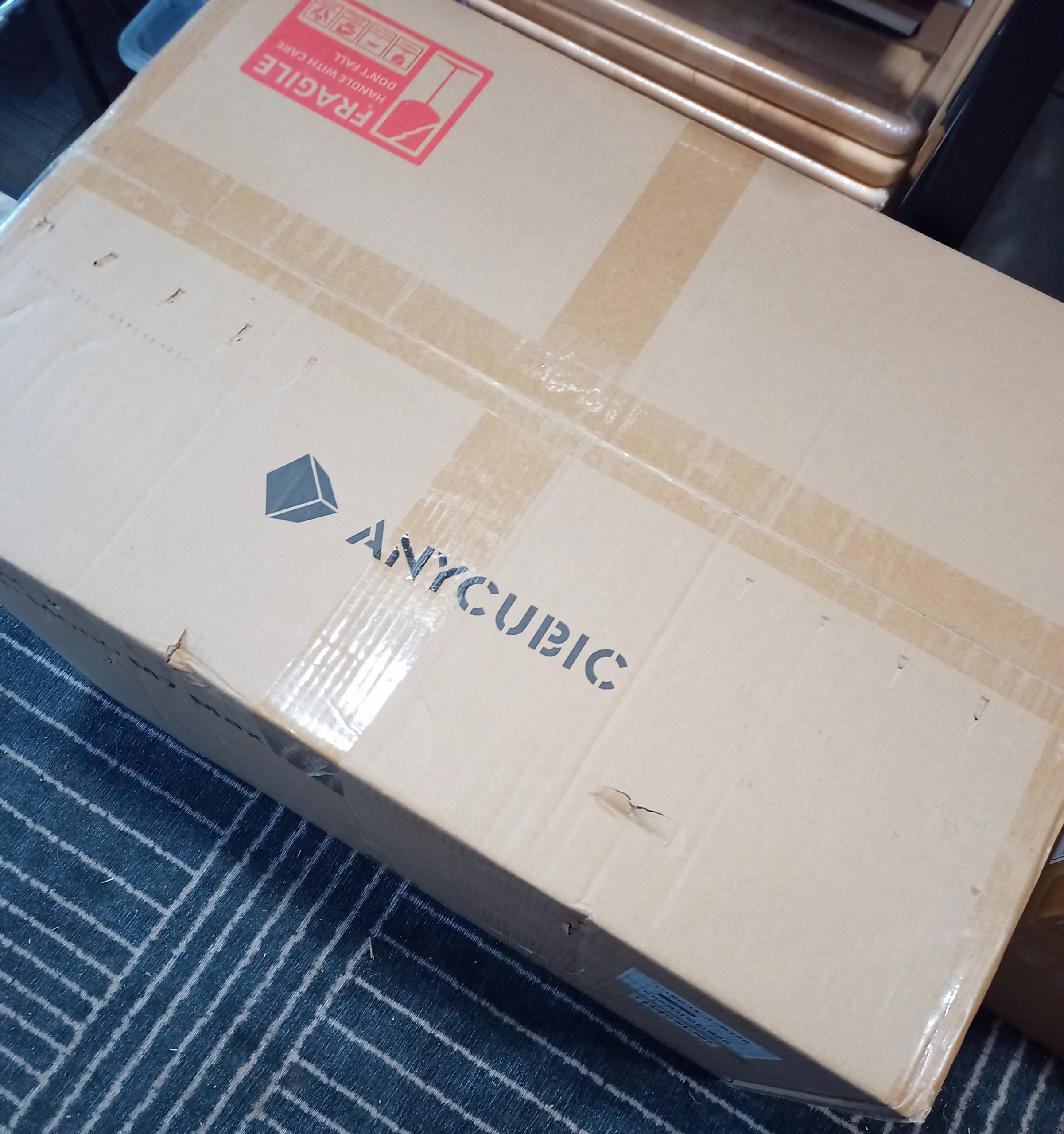
Wednesday started with a restocking run. We aim to stockpile 4-6 weeks of non-perishables with a single trip to Costco, but this time with an added layer of complexity: aggressively minimizing product coming from the country run by a tariff-obsessed madman. By the time I’d returned from that, the new resin printer I’d picked up at a decent discount for In3D arrived. I have a project that needs a big pint volume, and this thing is huge!
This box is big!
It’s so big that I had to do some significant re-arranging of the print shop. I have a mid-sized CNC machine that takes up a lot of room for nothing. It’s not in use because the amount of sawdust it creates would turn the rest of the shop into a disaster area. The printing operation prefers nice clean, dust-free, almost clean room conditions. The CNC will move to the garage, but at the moment the garage is a disaster area in need of a major renovation (not to mention a plan and a bucket of money) so the CNC sits here idle. I stole the clearance space the CNC would need to operate to move a shelf, thus giving me room to move a few other things around, which ultimately cleared space for this monster. By the time all that was done, I was both exhausted and “out of spoons”*. Setup, calibration and test prints have been deferred until I find more time.
Thursday was a trip to Toronto to go to the dentist. There are some good reasons why we endure a two hour drive each way to go for a routine dental appointment, but I won’t bother going into them here except to say that if you’re closer to the Sheppard and Warden area, look up Dr. Lindzon. I had gone in with fears that a broken tooth was going to require an expensive crown, but fortunately all that was required was a filling (okay, there’s one of the reasons; other dentists I’ve used would have had me into an expensive crown in no time, he’s more about the right level of care than bringing home the big bucks).
Then more re-stocking. First at Blue Sky Supermarket. Blue Sky is a massive supermarket full of foods you’d find in a Southeast Asian menu. If we can even find an ingredient out here in the country, the cost will be ridiculous. For example, we can buy a tiny bottle of sesame oil for $12 here or get a huge one at Blue Sky for $7. They also have a huge selection of spices and spice mixes at half the price of Costco’s limited selection. Even then, we couldn’t find a couple of items like Poha, a flattened rice common to Indian cuisine. Enter Namaste Indian Supermarket, where we picked up the last few items on the list including Poha and Fenugreek leaves.
This left us hungry, so we decided to look for fast food that can’t be found in our small town. This used to mean a quest for Burritos, but a year or so ago a branch of Fat Bastard Burrito opened in town, so this time we went on a quest for Shawarma. Our first stop was Towny Shawarama. A ramshackle pile of equipment in place of a cash register and a menu board with gaping holes where the prices should be put us off, despite a 4.8 rating on Google. Our next attempt was at Big Bites Shawarma, where staff were cleaning the front window as we approached. As my wife observed, if you’re wiping down the front window, everything else has already been cleaned. This was confirmed as we entered a spotless shop. I got a freakin’ huge Shawarma, she got a Falafel plate. Prices were more than reasonable, service was great and the food was excellent. Definitely earmarked for a return visit.
The drive back wasn’t bad, considering my low tolerance for urban traffic these days. I can still switch into “GTA Driving Mode”, which requires a strange mixture of patience, aggression, and courtesy, but isn’t much fun. As a friend once observed, the key is to be able to read the “automotive body language” of other drivers and respond appropriately. Still, driving in the city is far more demanding than the big source of complaint here, which is that sometimes it can take all of four minutes to get over the bridge. Four entire minutes! This makes the Toronto driver in me laugh, hard. Other than that, we had a mixture of snow and rain on the trip back, none of it heavy enough to be a concern.
Now here it is Friday evening. I’d started this post in the morning, hoping to fire it off quickly and get on with the day. Alas I had forgotten that we had a visitor scheduled to drop in this morning, so that plan was replaced by a relatively intense effort to clean the house. As it turned out, our guest couldn’t make it, but heck, the place looks better!
Oh yeah, the guilt. Tomorrow is the Annual General Meeting for Spirit of the Hills, our local arts association. I still have responsibility for managing our membership and over this week I have both failed to send our President a current membership report and to remind members who haven’t renewed that they have to do so before the AGM. Clearly some stuff needs to get done tonight! Then, last but not least there’s the feeling — I’m not sure which word describes it best, guilt, remorse, or frustration — the feeling that through all of this I’ve written maybe 100 more words of outline for the novel. A novel that I wanted to finish a year ago, and now each time I work on it, completion seems to get more distant. In part, I blame recently reading A Passion for Narrative, by Jack Hodgins and his emphasis on the benefits of reviewing, re-drafting, and repeatedly honing a manuscript until it’s the best it can be. This has left me in dread of being five years down the road, working on draft nine. It’s a somewhat irrational dread, but a writer’s mind can pay on them this way, and I am not immune.
* Spoons are a concept I first discovered in the autistic community. This references the limited pool of resources we have for doing things that neurotypical people seem to do effortlessly, such as interacting with other humans at a social level. At some point we run out of this resource, and are at risk of going into a meltdown. In this case, the spacial reasoning required for me to figure out how to move everything around and still make it all fit in some kind of workable configuration pretty much exhausted my abstract thinking resources, so doing any more actual work, or writing for that matter, wasn’t really possible.
A large part of running a web hosting business, which I did for nearly two decades, is protecting customers from scammers, spammers, and hackers. This was a constantly escalating battle, and now with the addition of a whole new class of aggressive AI scrapers, one of the main reasons why I got out of the business. Waging low-level warfare for two decades was enough. Time to rest.
For a flexible definition of “rest”.
The first thing I found myself doing, unencumbered by the risk of messing up customer sites, was to build a “web application firewall”. This application looks at incoming requests and applies a set of rules to determine if the query is coming from a “bad actor” or not. If it is, it takes an action ranging from delivering an error to blocking the source address in the network firewall. The rule set I have for this is just as aggressive as the AI scrapers, and this results in some behaviours that would be unacceptable to my former clients (for example, all of Meta/Facebook is blocked from accessing my sites).
One of the things I learned how to do was write rules for Spamassassin, the widely installed open source application that protects millions of users from the worst spammers. Like any defensive measure, attackers work to find ways to defeat these tools, which is why many spams contain big blocks of unrelated text at the bottom in a small font. That’s an attempt to game a Bayes filter by making the spam trigger words less prevalent.
SA rules are a little tricky to write, but with some practice, I learned to write custom rules that flagged common phishing attempts, big blocks of text in a small font, and more. None of these alone are enough to flag a message as spam, but they’re reliable indicators. cPanel allows each user to write their own mail filters, using a much more simplified set of criteria. So I set my SA rules to not score very high, then used the indicators to write cPanel filters. This gave users the power of SA without the complexity and was very effective.
But now I don’t have to worry about killing a customer’s email with a false positive. I can write rules that say if a message comes from a domain like example.ru.com and contains one of several keywords in Portuguese, it’s going straight to write-only memory. A rule like that is currently killing 20-30 spams per day.
This morning I got one of a relatively new class of spam, the AI-generated “I love your Instagram account” praising my content on IG in a way that sounds human but isn’t quite right at the same time. It’s kind of amusing to see an algorithm take a wild guess at what my accounts are about. (BTW the accounts are @alanlangford, @in3dca, and @silohouse.ca).
Time to kill that crap. Now the domain that “Maya” sent the email from, the domain linked in the email body, and an intermediate domain that the message was routed to each trigger new SA “Instagram shill” rules that let me trash the message. I took the opportunity to pull some similar rules from my cPanel filters and bring them into SA, which should make the whole process a little more efficient.


Recent Comments