No changes for the July 2025 slightly scary dumb password report. Another drop in access attempts this month. New and notable are a bunch of variations on “rootpassword”. I guess the script kiddies have had some luck with that elsewhere. Looks like there’s also some dumb spam bot trying to use the login form as a comment form. Duh.
Also not logged here is a big spike in attempts to hack through the XML-RPC call. I don’t have stats on those because all calls to xmlrpc.php on my WordPress sites are blocked, blocked, blocked.
I’ve replaced valid login user names with {username}, and names of the site with {site}, old compromised passwords with {compromised} and malware with {malware}. There were also a large number of seemingly random hex strings logged on one site. They’re pretty boring so I’ve collected those as one entry. If you think your username followed by a special character and a year is a secure password, you might be in for a shock. Actually, your user/site name followed by anything is a really bad idea.
These are failed password attempts across my WordPress websites. None of my sites are particularly popular. The amount of real traffic they get is small. So if you have a site and think hackers are ignoring it because few would care, think again. Every site on the net gets attacked like this. Every single one, including yours!
No changes for the June 2025 slightly scary dumb password report. Most notable this month is a sharp drop in access attempts, just 24% of the volume in May, although the diversity of passwords has only dropped to 64% of last month. This corresponds with my theory that spikes in December and April/May correspond to bored university students with nothing better to do than turn into script kiddies and try to wreak a little havoc. This theory has nothing to do with my personal experience as a bored university student. [cough]
I’ve replaced valid login user names with {username}, and names of the site with {site}, old compromised passwords with {compromised} and malware with {malware}. There were also a large number of seemingly random hex strings logged on one site. They’re pretty boring so I’ve collected those as one entry. If you think your username followed by a special character and a year is a secure password, you might be in for a shock. Actually, your user/site name followed by anything is a really bad idea.
These are failed password attempts across my WordPress websites. None of my sites are particularly popular. The amount of real traffic they get is small. So if you have a site and think hackers are ignoring it because few would care, think again. Every site on the net gets attacked like this. Every single one, including yours!
This applies to a lot of sites running on a a freemium business plan (for those unfamiliar with the term, a freemium model is when a service offers basic access for free, and then tries to up-sell you on premium features).
Most people are probably familiar with the concept: some new site shows up. It’s pretty cool, it’s free. You start using it. As you do, it’s constantly reminding (or outright nagging) you that there are lots of extra bonus features that you could get if you just sign up for a monthly fee (and get two months free if you sign up for a year!).
In an ideal world, those extra features are compelling enough that lots of people sign up. The company starts making money, investors are pleased. But then growth starts to level off, and although those paid users keep the company afloat, investors aren’t there for just a good deal, they want growth. They want to push to an IPO so they can cash out!
What’s a company to do? Easy, tap that free user base. The way most do this is to start clawing back on what’s free. For example, the unlimited length video calls that you signed up for are limited to an hour. Then later 30 minutes. And then ten. That’s enshittification.
Some users grudgingly switch to the paid model, investors are satiated for the moment. But all those other users start looking around for an alternative, and growth stalls again. Now the service gets sold to some bigger enterprise, folded in, and the free service either gets more crippled or discontinued. Remember when Slack was cool? Yeah. That.
For me, most of the time the cost of a subscription is just not something I’m willing to pay. Usually that’s because I don’t use the service enough to justify the cost, and sometimes it’s just because I’m a tightwad, and sometimes the pricing is so ridiculously high that it’s laughable. “Get this insight that might be meaningless for only US$249/mo?” No thanks.
What’s ironic is that often I’d be more than happy to pay something that gives the company a decent margin on the free stuff, but that option is almost never present. What if I have absolutely no use for those freemium features but I value the service enough that I’d like to see the services I have stay in place, instead of being eroded in a thousand cuts?
I’m going to use The Story Graph here as an example. I need to stress that this is an example. I am not picking on a site that I am actually enjoying. If anything, I’m looking for a way to help that fits my needs. StoryGraph plans are far more reasonable than most freemium sites. Their “plus” plan isn’t that expensive, just US$5/mo, or $50 per year. For that I get:
Invest in a Goodreads alternative not owned by Amazon. Hey that sounds great! I can really get behind that, although the use of “invest” here is disingenuous. “Fund” is more like it, unless someone plans to send a share certificate.
Custom Charts. Nah, couldn’t care less.
Extra Stats Filters. Nope. Don’t give a damn about my reading stats, either. Just want to track some books and maybe get some recommendations that don’t suck.
Compare Stats. Still don’t care.
Exclusive Charts. Zero interest.
Shape the roadmap. Be an unpaid focus group. Nope.
Priority Support. I don’t know how to break it to them, but nothing about my reading is mission critical. Take a couple of days to get back to me. Whatever.
(Unspoken) Get rid of the constant prompts to upgrade. Well, maybe not rid of them, but less frequent would be nice.
So there it is. The only thing I want is to see this site keep doing what I’m getting on the free plan. To take a chip out of Amazon’s dominance of the bookselling space. But that’s only worth about $15 per year to me. Do I have that option? Nope.
Truly, the fact that there’s no “just help us stay afloat” option makes me think that enshittification or sale is inevitable, and because of that, I’m actually more hesitant to put too much of my time into it. Pervasive enshittification has made me cynical. This is also why I have donated to my Mastodon instance, FreeCAD, LibreOffice, novelWriter, PHP, and others: I want them to be sustainable.
Changes for the May 2025 slightly scary dumb password report are fairly minor. I’ve rearranged the columns to put the frequency and ranking information first, and I’ve truncated really long passwords to make the layout work better. These truncations are marked with [cut]. The number of attempts is up from last month’s 5,375 to 5,695 attempts with 470 unique passwords, fewer uniques than last month. A new attack this month was was one attempt to inject some Java to expose /etc/passwd.
I’ve replaced my login user names with {username}, and names of the site with {site}, old compromised passwords with {compromised} and malware with {malware}. There were also a large number of seemingly random hex strings logged on one site. They’re pretty boring so I’ve collected those as one entry. If you think your username followed by a special character and a year is a secure password, you might be in for a shock. Actually, your user/site name followed by anything is a really bad idea.
These are failed password attempts across my WordPress websites. None of my sites are particularly popular. The amount of real traffic they get is small. So if you have a site and think hackers are ignoring it because few would care, think again. Every site on the net gets attacked like this. Every single one, including yours!
Cleaning up from an ice storm is a more involved process that it might seem at first. That’s not a surprise, but the extent has been larger than expected. What I didn’t expect is that ineptitude in another country would add even more complications.
I’ll start with the reasonable part. That Ego chainsaw that I was waiting on a month ago took nearly four weeks to arrive. That’s no surprise. I’m certain that the demand for chainsaws of all types spiked the day after the storm passed. The saw finally arrived last week and with other stuff going on it took a couple of days to get through the instructions, because nobody wants to accidentally sever a femoral artery. Then it took a bit of time to get over the intimidation factor of using a tool that can do something like that in a second. A nice day arrived so I put chainsaw oil in the unit and donned protective chaps and got them adjusted, then safety glasses, a hard hat with a screen and ear protectors. Then I found some smaller downed branches to start applying my new knowledge of how to cut trees. Finding a little success there, I carried on with larger branches. For years, I’ve been using a bow saw to cut off tree branches and break stuff down, and much of what I’ve learned doing that (thankfully without serious injury) works just as well with a power tool. there are two huge differences between an electric chainsaw and a gas powered one. Most notably, ear protection isn’t really required. The amount of noise it makes is minimal. Then there’s the ease of starting it. No jerking on cords and tweaking chokes to get it running. No either leaving it running while moving things around or trying to restart it each time. Push a button, squeeze the trigger, it runs. Just another reminder that powering things through an engine that has to contain powerful explosions is silly.
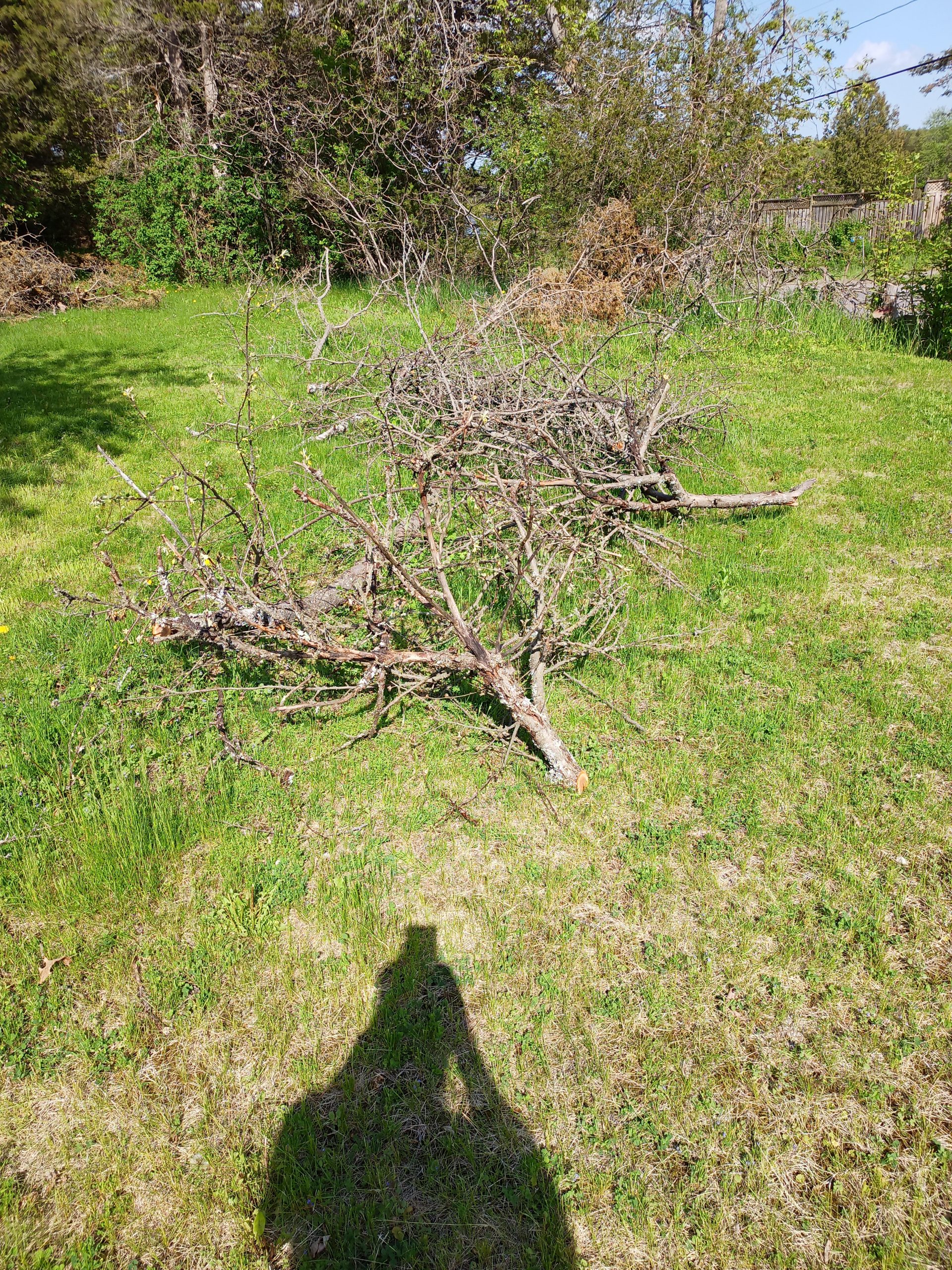
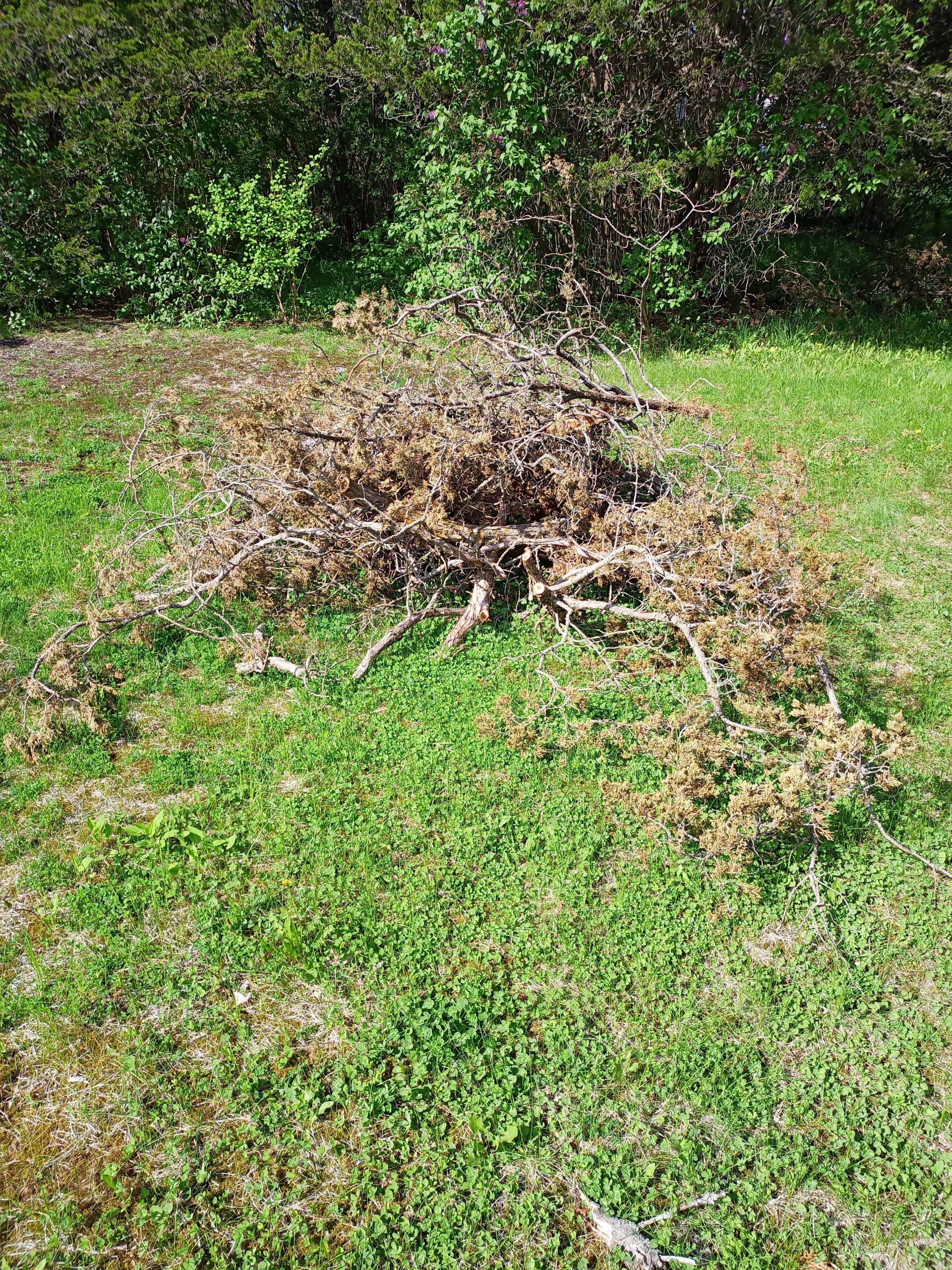
Two days later and we’ve got about ten piles of stuff broken down into pieces that are small enough to move.
Part of an apple tree downed by the storm, cut up.
Branches of a cedar tree
The plan is to break down much of this wood for use as kindling. We’re going to have a lot of it when we’re done, so it made sense to get a rack for that purpose, and here’s where we get into politics. We found a supplier of “outdoor stuff” and a rack that looked like it would meet our requirements. I placed the order. The next day we got a tracking number and a “guaranteed” delivery date. This highlights one of my common complaints about online stores: as soon as a shipping label is generated, the order goes into “shipped” status, but really it can take days before the order is actually prepared and shipped. Take the tracking number over to the shipping company’s website, and you get “we don’t have that package yet”.
But carriers aren’t perfect either. When the package didn’t show up and the carrier still didn’t have any information the day after the promised delivery date, I reached out to the vendor. As it turns out, the item was out of stock and I got a refund and profuse apologies. But I still need a rack, so I went to Plan B, returned to their site and discovered that almost everything they sell is now out of stock. Now why would that be? Because everything they sell is made in China and this company probably brought product into the US first, then shipped it up to their Canadian warehouse, and thanks to the current administration, China isn’t shipping anything to the US. My hope is that we’ll soon see the US cut out of this process, with direct shipments to Canada, but like anything else, that’s going to take some time.
On to plan C, where we find a supplier who still has stock and get some kindling racks on order. This is successful.
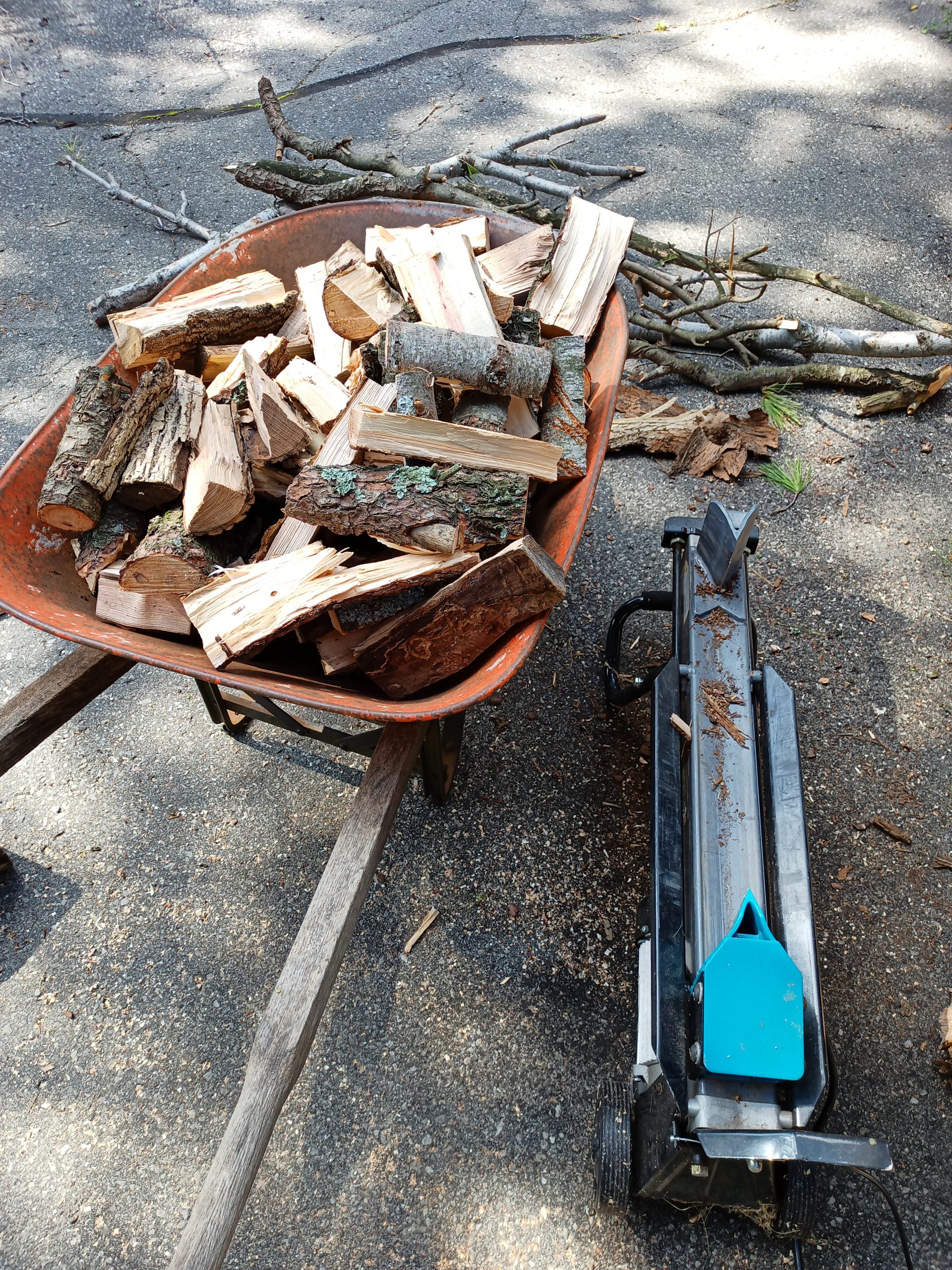
After hauling all suitably-sized branches up to the garage, I put the chainsaw and a log splitter to use to cut everything up into kindling-sized pieces.
Wood for kindling, some split, some not.
[That gas tank was to get a gas-powered generator running when the power was out. Naturally it wouldn’t start. Internal combustion engines suck.]
Split wood, ready to move
And finally I stacked them in our new “Plan C” rack:
Kindling on a rack.
By the time we’re done, I expect that rack to be filled to capacity, and we have a second one just like this one that we’ll use for smaller pieces.
Then we’ll be ready for Step Four, which will be call in the professionals to handle that Mulberry tree and several others. In turn that will require another round of long splitting and kindling-making. By the time fall arrives, we might even have the whole mess cleaned up!
I’m going to start this one with a disclaimer: much like the folks who write for Rebel Media, I’m not a journalist. I’m reacting to a single social media post and the full story might be completely different. In part what I’m hoping to accomplish here is to inspire an actual journalist with more skills and resources to delve into this, get more facts, and if that story is congruent with what I write here, make as many people as possible aware of it.
Here’s the post:
Sure enough if you head over to Krauss’ Amazon page, her bio mentions the Fatality series, and that series doesn’t show. Links to the series basically come up with a 404. Next let’s head on over to the publisher of the series Dream’s Edge Publishing (and ignore that it’s a god-awful Wix site). Every work on that site links to Amazon (US, CA, and UK) and they’re all just as dead.
I suppose there could be some other reasons for this. Amazon is chock full of byzantine rules, bogus DMCA claims, and a notable inability to connect to an actual person to resolve issues. But in light of the current political environment in the US, and Amazon’s dependence on AWS contracts with the US Government, it sure bears more investigation.
No matter what the reason, this event brings home the peril of relying on Amazon’s market domination to run a publishing business. Yes, it’s a ton of extra work to make sure your books are available on the dozens of other platforms out there, all for maybe 30% of the market. But at least get onto Kobo and do direct e-book sales or you could find yourself dead in the water in an instant.
Update:
Krauss has received an update from Dreamer’s Edge:
Dear Vanessa,
We have had some bad news about publishing on Amazon and they have terminated our KDP account because of “attempting to manipulate sales.” We have contacted them to protest and ask for further information and how we can best appeal this decision. They have now replied but not given any further information and stated “After reviewing your response, we have reevaluated your account and are upholding our previous decision to terminate your account and remove your books from sale on Amazon” This has been a shock to us, if we do continue to persevere with legal action to get our account reinstated this may take some time and even then, there is no guarantee Amazon will change their decision.
Therefore, we are giving you back the publishing rights forthwith, of all your work.
Take this message as a legal right of transfer of publishing rights back to you the copyright holder.
It appears that Dreamer’s Edge has tripped over one of those byzantine rules where some algorithm has flagged the account. I’ve experienced an issue like this with one of the other behemoths in the web space, and the only thing that saved my butt is that I was actively advertising on the platform at the time. It was only when I said I was “saddened by the decision and regrettably had to cancel my ads in response” that the decision got changed from a ban to a warning. At least back then they’d tell you which rule you tripped over. Now it’s just “you broke it, bye forever.”
I suspect that Dreamer’s Edge assessment that legal action might be unsuccessful is correct. There’s no harm in sending a lawyer’s letter by registered mail, possibly going so far as Small Claims Court, but in all probability they’re dead in the water. Kudos to them for doing the right thing in this circumstance and returning the publishing rights.
This month for the April 2025 slightly scary dumb password report filters “Log In”, which has been reported as the most popular password in all previous reports. Looking at the raw data, it appears to have been included erroneously. Despite that, the number of attempts is up from last month’s 4,951 to 5,375 attempts with 540 unique passwords.
I’ve replaced my login user names with {username}, and names of the site with {site}, old compromised passwords with {compromised} and malware with {malware}. There were also a large number of seemingly random hex strings logged on one site. They’re pretty boring so I’ve collected those as one entry. If you think your username followed by a special character and a year is a secure password, you might be in for a shock. Actually, your user/site name followed by anything is a really bad idea.
These are failed password attempts across my WordPress websites. None of my sites are particularly popular. The amount of real traffic they get is small. So if you have a site and think hackers are ignoring it because few would care, think again. Every site on the net gets attacked like this. Every single one, including yours!
I’m going to dive into a specific case of a “beta reader” here, but the principles are the same for just about anything related to the process of getting a book published.
First, a reminder of the general rule: If an organization is pretending to be a legitimate traditional publisher and they ask you for money, then they’re not. They’re one of a vanity publisher, a hybrid publisher, or a scam. Of those three, the only time you’re likely to see value for your money is if they’re hybrid, and even then check references, then see if you can check authors who have used them but aren’t on the reference list.
This morning, someone posted this on a writer’s group:
My name is Karen [redacted] I’m a Beta Reader who helps authors improve their work with clear, thoughtful feedback. If you’re preparing to publish, I’d love to support you—with both feedback and professional formatting to get your book ready for readers.
I was going to post the rest of the pitch, but the post was been removed, either by the group admin (or by the poster after my response to asking for references). “Karen” offered to be a beta reader, to provide feedback, and to help with book formatting because “she” just loves to help authors.
UPDATE: Now “she” is commenting on posts, so I got the full text again, now above.
The first two flags are right there in the pitch. There’s no mention of genre. It’s not often that someone is an avid reader of any genre, and even if they are, how much genre-specific feedback could they offer? Suspicious. Second is the mention of “book formatting”. That sounds like something one might be charging money for. My first thought is that this is a lead in to an outright scam, where “Karen” loves your book so much that “she” wants to hook you up with a friend in the [scam] publishing business. For only US$1,500 you can be $5,000 poorer! (Seriously, that’s how it works, once you send money, they know they have a mark and they keep asking for more money for printing, marketing, etc. etc. until you either clue in or run out of money).
There’s another possible risk here, and it’s huge: you send your nearly-finished manuscript to someone you don’t know, next thing you know, your book is up on Amazon under another name, and since they “published” first, getting it taken down is borderline impossible. I can’t think of a worse scenario.
Here’s a general process to go through when checking anything like this out: go to the user’s profile and take a look at their personal posts, where they claim to be from, and their friends list. Reverse image search their profile picture with TinEye.
This is what I got for “Karen”:
“Karen’s” surname is a common given name, not a surname. Okay, maybe they’re using two given names for privacy reasons but… suspect nonetheless.
The profile image was just some stock shot of a pen on paper. That’s not even worth searching. But if they have a head shot, then TinEye is great. These days there’s fewer hits because the scammers are using AI to create new people each time, but if they’re lazy it’s not uncommon to find the image listed on scam tracking sites. Still, a pen and paper is pretty weird for a personal page. Flag number three.
There were no posts to this account before December 4, 2024, roughly five months ago. That’s suspect. Flag number four.
“Karen” claimed to be born and raised in New York City. Let’s take a look at the 400+ friends associated with the account. Almost all of them are based in India, and nearby Asian countries. In the first 200 or so, not one in New York, and only two in the US[LN]A. Flag number five.
The post feed is all news-y, current posts feature the current president doing various things, then back in December they’re Biden doing various things. Not a single personal or reading-related post. Flags six and seven.
Now we do a web search, there’s no indication of this person on any of the reading-related sites (Goodreads, The Story Graph, etc.) Flag eight.
Head over to Linkedin (if you can stomach it), search the name there. Not a single profile with that name. Flag nine.
There’s no blog/website/presence at all under that name, save for this Facebook profile. Flag ten.
Ding! Ding! We have a loser!
Five flags is more than enough to call this a scam, but I thought I’d go through the whole process to illustrate what the first steps should be to avoid getting ripped off. Even when someone passes these checks, you’re back to the general rule above: obtain and check references. The number of people out there looking to take advantage of authors who are desperate to get their work out there is off the charts.
I just read an essay, Why I Cannot be Technical, by Dr. Cat Hicks. It’s a long read and it offers a personal view into her thinking, her work, and what it is to be Technical (and although she doesn’t use the phrase, I read one part of what she’s calling Technical as what I’d call “Bro Culture in Tech”, more specifically in software development).
There’s a lot packed into that essay and for anyone working in software, or working for a company that is focused around software, I’d recommend first a careful read with a view to deconstructing many of the overlapping topics there, then following those to her work on software developers and technical teams.
I’m not really sure how this post is going to go, but I expect it to have a similar number of overlapping topics. My apologies in advance if this also requires some diligent reconstruction.
I’m an outlier. I think a lot of people in software development have characteristics that a diagnostician would associate with autism, and I’m certainly one of those people. This has been the basis of much of my success. In particular, it’s allowed me to seek and thrive on the most inhuman of projects, the high-pressure tight-deadline, hero-or-zero projects that I’ve always enjoyed and delivered on. It’s also been the basis of my under-performance, my inability to integrate into a team well, my proclivity to speak the truth, to say “hey what about that elephant?” in meetings, the times when I state something I think should be self-evident, only to be met with a few seconds of silence and then “well Alan, why don’t you tell us what you really think?”, and my below-par performance when the building is not actually on fire.
For this reason, aside from a few brief periods where I was an actual employee, and until I got utterly derailed in my mid 40’s (more on that later), I’ve been a contract developer, or in modern parlance, “gig worker” for most of my career. I set up my first home office in 1981, when it was such a radical idea that many people couldn’t get past the cognitive disconnect the phrase inspired. Many of my peers (or more specifically my male peers) wound up moving to the US, to Silicon Valley, Redmond, or the Tech Triangle in NC. They set down roots, earned salaries that I couldn’t dream of, put their names on patents, and rose through the ranks. Mainly retired now, they travel the world, visit grandchildren, and so on while I still work to give my life any meaning that endures beyond the people who will remember me when I’m gone.
Even when I found long term contracts where I could be successful, my tenure was limited. I will digress into an example where shortly before I arrived a woman was parachuted in as Director of IT and proceeded to engineer the bro middle managers out. This company had a department of maybe 15 staff, and three, count ’em three middle managers. For context, we’re talking the mid-90’s here, well after most companies had thinned their middle management ranks to the bone, so this was borderline archaic. The manager I reported to had this incredibly complex system of spreadsheets that he used to explain why a ten minute change to a system would take three months to deliver. He was the first to go. Terminated shortly after the new director correctly determined that 85 days of that three months would be consumed by staff filling in forms and his tweaking those dreaded spreadsheets. He did not go softly, at the party thrown for his departure at a local strip club, a long-standing departmental tradition, he ranted about how incompetent she was, how the entire department was going to hell. Many male staffers in attendance agreed vigorously, causing the exposed breasts of the women sitting on their laps to jiggle. I may be a heterosexual male who is also fond of boobs, but I still can’t find words to capture my revulsion, my disgust at this display. The other managers and a bro staffer all took this to heart, found other jobs and resigned in short order. It was only after the third departure that one of the women in our department (our female ranks had doubled to two, thanks to new hires) suggested that maybe, just maybe we could have have her manager’s departure party at a place where she too could feel comfortable. What a radical idea!
I spent the better part of two years at that job, and wrapped up a major project. In the absence of middle managers, I reported to the director, like everyone else. When offered a contract extension, there wasn’t a critical project coming up, and I sensed I would get bored, under-perform, and eventually not be offered another extension. Cycling back to what Dr. Hicks references in her post, she built a much more human IT department during her tenure. The mood and morale of that group was far higher when I left than when I arrived. I laughed a bit after writing that, because in part that humanity also made it a place where I was less likely to excel.
A few years earlier I got called in to save a project that was unsalvagable. I can work the occasional miracle, but not after the customer has sent a letter that amounts to “stop all work and get your stuff out or it’s going into a dumpster, any responses should go to our lawyer”. But that particular disaster was a symptom of some much deeper issues, and in short order I found myself responsible for all of engineering, in charge of a department of some 15 software developers and engineers. Just one of those was female and on the customer engineering side of the shop. During my introductory meetings with my new team, she’d identified a stability issue in our product but said nobody would listen to her (anyone surprised?) I took the issue up with our lead developer who dismissively asserted that the product was perfect, and that it was an application issue. So I bought a diagnostic tool that simplified the identification of software flaws, gave it to her, and let her run with it. A day later, she’d identified the null pointer dereference that was crashing the system (and a handful of other customer installations). We presented this hard evidence to the lead developer (together, because I expected if she gave it to him alone, it would be dismissed yet again), got the problem fixed and in the process finally got a system in production sufficiently stable that the customer released a rather substantial final payment. I also put a lot of effort into a “check your ego at the door” culture. We had some very talented developers and we had some average developers, but my experience is that everyone has strengths and most of the time you can find a place to let them thrive. One wasn’t the best at writing new code, but was an absolutely meticulous tester. Another was extraordinary when communicating with customers. I tried to fit them into places where they could use their strengths. One day just before a long weekend, I had a screaming match with our CEO, who attempted to manufacture a crisis that would have kept our team working through the weekend. Personally, I’ve never been much into this work-life balance thing, but the people who reported to me were largely neuro-typical, and I felt I had a responsibility to give them what balance I could. False crisis averted, they got a much deserved weekend and the knowledge that I’d risk everything to defend them. After a year, the problems I could fix had been fixed and I moved on. I hope that I left a more human friendly place in my wake.
All that is a prefix to the career path of the woman in this story. Some time after I left, she moved to another company to run a team of her own. This felt like an achievement. Someone I’d mentored went on to a leadership role in tech! But then not too long after that she switched to a sales role. My guess is sales offered more money, more humanity, less sexism, and more people who would actually listen to her. A few years later I worked with a founder of the company she went to on another project and if anything this reinforced my guess.
In my experience, software development is a career that does an excellent job of chewing people up and spitting them out. Most of the men I know in my cohort got out of coding early by their 30’s, the women years earlier than that. Some moved to management, some to things like technical sales support, but the vast majority into something distant from writing code (for example, farming). I can think of just one woman who stuck with it through to retirement. I think the industry favours young developers straight out of school not only because they are quick to learn and become productive, but also because they’re easier to exploit. It’s harder to put in twelve hour days when you have to go pick your kid up from daycare because your wife left you for working twelve hour days all the time.
I spent much of my career working for small businesses and startups, many of which were working on ideas that could have become billion-dollar businesses, putting in the stupid hours, all in hopes of one day coming out with a massive payout that I could subsequently use to build rocket to Mars and the like (yep, I thought much like “that guy” as much as it pains me to say that now). I think this is still the underlying driver that lets the software industry abuse its practitioners: the “hey if this works, the options will pay out in the millions and it will all be worth it” myth. Legends of early Microsoft employees cashing out in the millions looms large in tech culture to this day. All this despite the fact that large investors have come up with elaborate ways to screw employees out of any real wealth, with pre-IPO dilutions, layoffs just before options trigger and other manoeuvres from the Capitalist Asshole Playbook.
During the dot com boom, two friends of mine got involved in a startup that scored, big. They both came out wealthy enough to never need to work again, but not wealthy enough to throw them into the ranks of the uber-rich. One of them was more than a friend. We were close enough to be brothers. Instead of all that money becoming a platform to do more, to do better, it triggered a series of events that caused him to lose his way and within a few years he was gone. Gone in his early 40’s, with so much more left to do.
It took some time for this loss to take it’s full toll on me. Subconsciously, the entire point of becoming rich enough to do “great things” was eradicated, replaced with become rich and spend the rest of your life shepherding your assets as investments or do something dumb that ends your life. A main pillar of how I framed my existence had been destroyed. After he died, I did a couple more “impossibility remediation” projects and then slipped into a fifteen year-long set of cycles through mild to moderate depression alternating with thinking I’d pulled out of it. The years that should have been my most productive were so attenuated that they were essentially lost. I kept coding though, offering up some products that were minimally successful in their niche markets (successful in that they at least paid back more in revenue than the hours I put into them). I wrote some reasonably cool open source stuff and made several attempts at bringing new ideas to a minimal viable product stage, without success. Even in less severe cases like mine, depression is a bitch. There’s no real way to communicate that unless you’ve been there, but what I can say is that I remain exuberant at having gotten past it, am as confident as possible that it’s not coming back, yet vigilant for some other thing that could trigger a brand new wave.
As I write this, I wonder (as you probably do, having gotten this far) what my point is, and how it relates to Dr. Hicks’ essay.
In part I think I’m trying to illustrate by example a point that Hicks makes.That even when one is Technical (in the specific way that she uses the term), it is not possible to be Technical. Technical is a construct we willingly create for ourselves and subscribe to provide meaning to our work, our lives. It isn’t real, and like any construct it makes those who believe it subject to manipulation by others. Capitalism is more than happy to perform that manipulation to it’s advantage and to the detriment of people, of humanity.
My other point is that Technical, as currently practised, is intrinsically elitist, sexist, ableist (possibly unless you’re a functional autistic), and a whole mess of other negative -ists. I think anyone in the field, even the boy genius super-programmers, will benefit greatly by developing an understanding of Hicks’ work. I mean, even if your own personal development powers are god-like, understanding what she’s learned will benefit the semi-useless plebes on your team and help them get out of the way, so it’s like totally worth it. Yes, you may read that last sentence fragment in Valspeak.




Recent Comments